
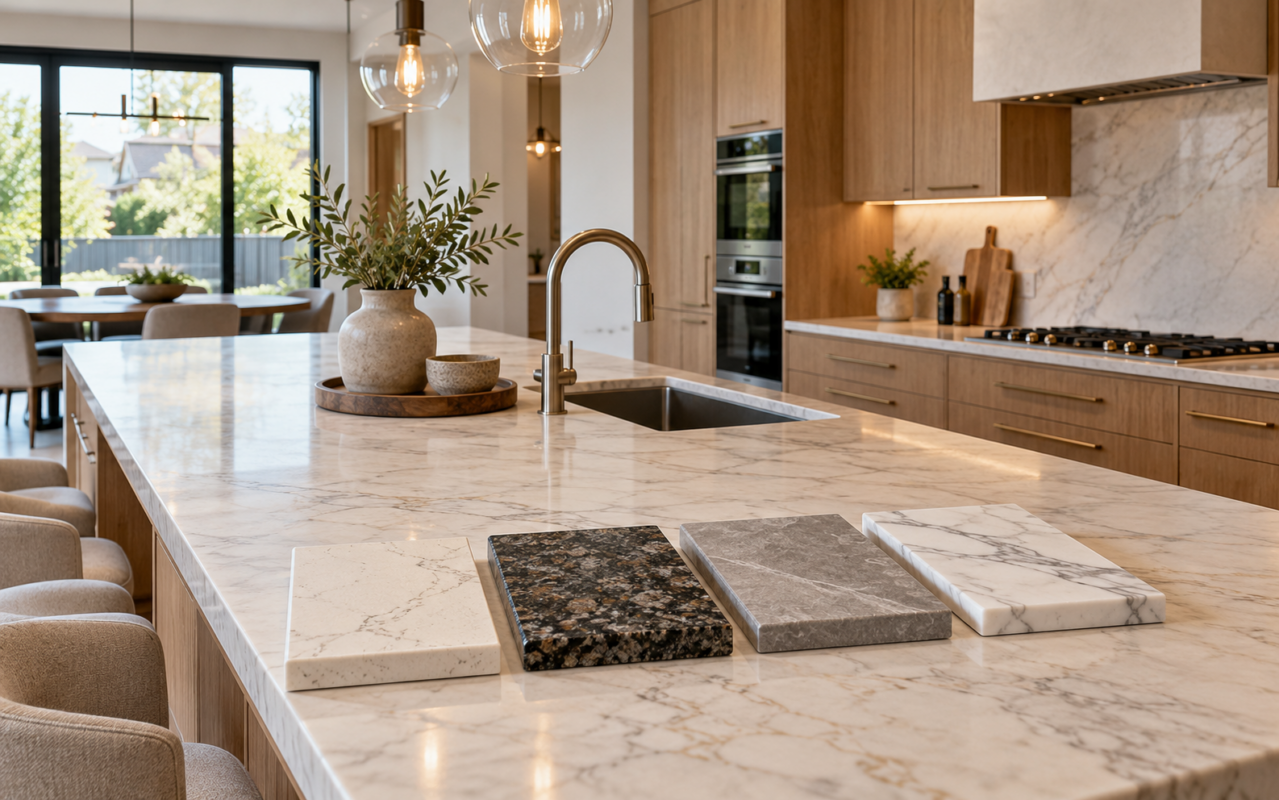
Kitchen Countertops in Toronto: Quartz, Granite, Porcelain & Natural Stone Guide
A countertop that works beautifully in a spacious detached house may present very different design and installation considerations in a downtown Toronto condominium.
For homeowners exploring kitchen countertops in Toronto, the decision involves more than selecting an attractive stone colour. Material performance, daily maintenance, available space, installation access and total project cost all matter.
Quartz, granite, porcelain and natural stone offer different advantages depending on the kitchen layout and how the space is used.
A compact condo renovation may call for carefully planned seams and precise appliance cutouts. A larger family kitchen might prioritize generous preparation surfaces, an island and an easy-to-maintain finish.
Understanding these differences can help you select a countertop that suits your home before the fabrication process begins.
Quick Answer: Which Countertop Material Is Right for a Toronto Kitchen?
Quartz is worth considering for homeowners who prefer an engineered surface with relatively straightforward maintenance. Granite provides naturally varied stone patterns, while porcelain offers manufactured designs and product-dependent heat resistance. Marble and other natural stones appeal to homeowners seeking distinctive natural characteristics but may require additional care.
The appropriate choice depends on cooking habits, budget, design preferences, maintenance expectations and the actual slab specifications.
1. Quartz Kitchen Countertops in Toronto
Engineered quartz is produced using mineral content, binders and pigments. The exact composition and performance characteristics vary by manufacturer.
Quartz is available in a range of colours and patterns, including restrained white designs, darker contemporary finishes and surfaces resembling natural marble.
Why Consider Quartz?
For many homeowners, the attraction is a combination of design consistency and routine maintenance.
For example, Caesarstone’s quartz care guidance describes its engineered surfaces as nonporous and suitable for cleaning with warm water, mild detergent and a soft cloth. It also recommends using trivets beneath hot cookware.
Other considerations include:
- Manufactured colours and patterns that can coordinate with cabinetry.
- Products that do not require periodic sealing.
- Different available finishes and edge designs.
- Stain resistance suited to everyday kitchen activity.
- Options for islands, countertop runs and backsplashes.
However, stain resistance does not mean stain-proof, and quartz should not be treated as completely heatproof.
Quartz for Toronto Condominiums
In a compact kitchen, a consistent slab pattern can help create a cohesive appearance.
Light-coloured quartz paired with warm wood cabinets, for example, can support a restrained contemporary design.
Still, the layout must accommodate fabrication requirements. A long countertop run may need a seam, and a large island section may create delivery challenges in a building with limited elevator space.
These are project-specific considerations rather than problems unique to quartz.
2. Granite Kitchen Countertops in Toronto
Granite is a natural stone distinguished by its naturally occurring mineral patterns and colour variations.
Unlike engineered quartz, granite is quarried and fabricated from natural stone.
Individual slabs can feature subtle speckling, pronounced movement or combinations of different mineral colours.
For homeowners planning a kitchen renovation in Toronto, this offers an opportunity to introduce a surface with a naturally varied appearance.
What Makes Granite Different?
Its appearance is one of its most noticeable characteristics.
Two slabs of the same named variety may differ in their distribution of veins, crystals and patterns.
That makes full-slab viewing useful for projects where the countertop will become a major design feature.
Granite is also a durable material, although edges can still chip and the surface should be protected from excessive impact or sudden temperature changes.
Does Granite Require Sealing?
Not every granite countertop requires annual sealing.
The Natural Stone Institute explains that many granite countertops do not need sealing, although some benefit from an appropriate sealer. The recommendation depends on the particular stone and its treatment.
Before purchasing granite, ask about the care requirements for the actual slab rather than assuming that all natural stones require the same maintenance schedule.
3. Porcelain Kitchen Countertops in Toronto
Porcelain offers another approach to contemporary kitchen design.
Large-format porcelain slabs are manufactured ceramic surfaces available in different colours, patterns and finishes.
Some products resemble marble, limestone or concrete, while others feature distinctive contemporary designs.
Why Consider Porcelain?
Selected porcelain products offer low water absorption, stain resistance and strong heat performance.
Caesarstone Canada, for example, states that its porcelain countertops can accommodate cookware removed from an oven or cooktop, while recommending insulated mats beneath devices that produce sustained heat. Its guidance also warns against hard impacts on exposed edges.
These characteristics can make porcelain worth evaluating for households with particular cooking or design requirements.
However, performance specifications are product-dependent and should not be generalized to every porcelain slab.
Fabrication Matters With Porcelain
Porcelain fabrication requires careful attention to details such as:
- Slab thickness.
- Countertop support.
- Sink and cooktop openings.
- Edge profiles.
- Mitred corners.
- Waterfall panels.
- Transportation and handling.
Some decorative porcelain products also have a surface pattern that does not continue identically through the body of the slab.
This can influence the appearance of an exposed edge.
Before ordering, discuss the intended edge construction and finished appearance with the fabricator.
4. Marble and Other Natural Stone Countertops
Marble is known for its natural veining and distinctive appearance.
It can complement a range of kitchen styles, from traditional interiors to minimalist contemporary spaces.
However, selecting marble requires understanding its maintenance needs.
Is Marble Suitable for Everyday Cooking?
Marble can be used in kitchens, but some everyday substances can affect its finish.
The Natural Stone Institute explains that acid-sensitive stones can develop etching when exposed to acidic substances. Products such as lemon juice or vinegar can therefore present a concern for some natural-stone surfaces.
Sealing may improve resistance to some staining, but it does not make marble immune to acid etching.
Homeowners should weigh this maintenance consideration against the appearance they want.
What About Quartzite?
Quartzite is a natural stone and should not be confused with engineered quartz.
Depending on the particular slab, quartzite can provide distinctive natural movement and colours.
Its maintenance and fabrication requirements should be assessed according to the actual material.
If you are considering quartzite or another speciality natural stone, confirm its availability and technical specifications before ordering.
5. Quartz vs Granite vs Porcelain vs Marble
The table below summarizes general differences. Exact performance depends on the selected product and its care requirements.
| Feature | Quartz | Granite | Porcelain | Marble |
| Type | Engineered surface | Natural stone | Manufactured ceramic | Natural stone |
| Appearance | Manufactured designs | Naturally varied | Manufactured designs | Natural veining |
| Sealing | Generally unnecessary | Depends on stone | Generally unnecessary | Depends on stone |
| Maintenance | Relatively simple | Stone-specific | Relatively simple | Greater acid sensitivity |
| Heat | Use trivets | Avoid thermal shock | Strong for some products | Avoid thermal shock |
| Edge concerns | Chipping possible | Chipping possible | Exposed edges need care | Chipping possible |
| Pattern variation | More controlled | Natural variation | Product-dependent | Natural variation |
Rather than choosing a material based on one characteristic, consider how its overall care requirements and appearance fit your kitchen.
6. What Should Toronto Homeowners Consider Before Buying?
Condo Kitchens: Think About Delivery Access
Countertop planning in a condominium can involve logistical considerations beyond the slab itself.
Before approving a large-format countertop, confirm:
- Building elevator dimensions.
- Available service-elevator bookings.
- Loading and unloading arrangements.
- Hallway and doorway clearances.
- Access to the kitchen.
- Building renovation requirements.
- Whether the slab can be transported in one piece.
A countertop that fits the kitchen on a drawing must also fit through the building on installation day.
If access restrictions require dividing a long countertop into multiple pieces, seam planning becomes especially important.
These considerations should be confirmed for the actual building rather than assumed for every Toronto condo.
Detached Houses: Consider Islands and Larger Layouts
Toronto homeowners renovating larger kitchens may need to make different decisions.
For example, adding a waterfall island introduces vertical slab sections that require additional material and fabrication.
A full-height stone backsplash may also require careful layout planning around windows, outlets and adjoining surfaces.
For these projects, ask your fabricator how slab dimensions, patterns and openings influence the final design.
Choosing Countertop Colours
Countertop colour should be evaluated alongside cabinetry, flooring and the available lighting.
Lighter surfaces may create a different visual effect from dark stone, while strongly patterned slabs can become a focal feature.
A useful approach is to compare samples in the actual kitchen during both daylight and artificial lighting conditions.
For natural stone, viewing the full slab can reveal pattern differences that are not obvious from a small sample.
7. How Much Do Kitchen Countertops Cost in Toronto?
Kitchen countertop pricing in Toronto depends on the material and the complete project scope.
A straightforward countertop replacement can have different fabrication requirements from a kitchen featuring a large island, waterfall panels and full-height stone backsplash.
Main Cost Factors
| Factor | Effect on the quotation |
| Material | Different products, finishes and slab selections have different prices. |
| Countertop dimensions | More material may be required for larger surfaces. |
| Slab quantity | Layout and pattern matching can affect slab usage. |
| Edge profile | Complex edges require additional fabrication. |
| Sink and cooktop openings | Cutouts must match the selected fixtures. |
| Waterfall panels | Add material, fitting and finishing work. |
| Backsplash | Full-height slabs add to the overall project scope. |
| Existing countertop removal | May involve a separate service. |
| Access | Stairs, elevator restrictions and delivery conditions can affect installation. |
| Installation | Fitting, seam finishing and site requirements contribute to the final cost. |
Do not compare material-only quotations with fully installed prices.
Request a written estimate showing what is included in the project.
In particular, confirm whether the quoted price covers templating, fabrication, edge finishing, cutouts, delivery, installation, removal and applicable taxes.
A Toronto homeowner should obtain a project-specific quote rather than relying on an unsupported universal cost per square foot.
8. Why Custom Fabrication Matters
Even a carefully selected slab needs accurate fabrication before installation.
The process generally includes:
- Confirming the countertop material and layout.
- Completing final measurements or templating.
- Planning slab positioning and seams.
- Fabricating the required countertop pieces.
- Creating sink and cooktop openings.
- Finishing edges.
- Delivering and fitting the countertops.
- Completing the installation and final checks.
The exact sequence depends on the material and the project.
For Toronto renovations, the planning stage should also account for access conditions, cabinetry readiness and any work requiring separate trades.
Homeowners should understand which services are included before placing the order.
9. Choosing a Countertop Supplier and Fabricator for a Toronto Project
A countertop supplier provides access to surface materials.
A fabricator prepares those materials to fit the project.
An installer positions and secures the fabricated countertops at the property.
Some businesses provide all three services.
Before selecting a company, ask whether it can explain the complete workflow and who is responsible for each stage.
Useful questions include:
- Can I view the actual slab?
- Who completes the final measurements?
- Who fabricates the countertop?
- How are seams planned?
- What edge profiles are available?
- Are sink and cooktop cutouts included?
- Who handles delivery?
- Are removal and installation included?
- How are condo access requirements handled?
- What warranties apply?
Clear answers make it easier to compare quotations based on more than the headline price.
10. Kitchen Countertops for Toronto Projects With GTA Marble
GTA Marble’s current website identifies the company as a supplier of European quartz and a fabricator and installer of quartz, porcelain and natural stone.
The company also maintains collections covering quartz, porcelain, marble and natural-stone categories.
Toronto homeowners considering custom countertops can contact GTA Marble to discuss material options, project measurements, fabrication and installation requirements.
The company is physically located at 7025 Tomken Road, Mississauga, rather than in Toronto.
For a Toronto project, confirm site-specific delivery arrangements, installation availability and other logistical details when requesting a quotation.
Frequently Asked Questions
What countertop material should I consider for a busy Toronto kitchen?
Engineered quartz and appropriate porcelain products are worth considering when easy everyday cleaning is a major priority. Granite may also suit a busy kitchen, depending on the specific stone and maintenance requirements. Compare the actual product specifications rather than assuming one material is suitable for every household.
Are porcelain countertops better than quartz?
They have different characteristics. Certain porcelain products offer strong heat performance, while engineered quartz is commonly selected for its consistent designs and straightforward maintenance. Fabrication details, edge durability and manufacturer care instructions should also be considered.
Can large stone countertops be installed in Toronto condos?
They may be installed where building access, slab dimensions and installation conditions permit. Check elevator dimensions, loading arrangements, access restrictions and whether the proposed countertop needs to be fabricated in multiple sections.
How do I compare countertop prices in Toronto?
Compare quotations covering equivalent materials and project requirements. Check whether each includes measurements, fabrication, edges, cutouts, delivery, installation, removal and taxes. A price per square foot may not capture every element of a custom project.
Is granite more difficult to maintain than quartz?
Granite’s maintenance depends on the particular stone and treatment. Engineered quartz generally does not require sealing, while some granite surfaces may benefit from it. Follow the specific surface-care guidance instead of using a fixed sealing schedule.
Can I order countertops without replacing my kitchen cabinets?
In some cases, yes. Existing cabinets may be retained if their condition, support and alignment are appropriate for the selected countertop. A fabricator should assess the actual installation conditions before finalizing measurements.
Final Takeaway
Choosing kitchen countertops in Toronto involves evaluating the surface material alongside the design and practical requirements of your home.
Quartz offers engineered design consistency and straightforward care. Granite provides natural variation. Porcelain offers additional manufactured-surface options, while marble and other natural stones introduce distinctive visual characteristics and specific maintenance considerations.
Countertop dimensions, slab layout, fabrication, delivery access and installation also influence the final result.
For Toronto homeowners comparing options, GTA Marble provides a point of contact for discussing quartz, porcelain and natural-stone materials, custom fabrication and project-specific installation enquiries.
Planning a kitchen countertop project in Toronto?
Contact GTA Marble to discuss your preferred material, kitchen dimensions, fabrication requirements and the availability of installation for your property.
Phone: +1 (647) 860-2420
Website: www.gtamarble.ca
Business location: 7025 Tomken Road, Mississauga, Ontario.